
When we think about how children learn and develop intellectually, many people naturally lean toward Jean Piaget’s ideas. Piaget viewed children as “little scientists” who explore the world independently to build knowledge. However, another brilliant thinker offered a different, yet just as powerful, perspective.
Lev Vygotsky, a seminal Soviet psychologist, argued that learning does not happen in a vacuum. Instead, he believed that cognitive development is deeply rooted in our social interactions, culture, and language.
In this guide, we break down Vygotsky’s Socio-Cultural Theory of Cognitive Development and explore the core concepts that still influence modern classrooms and parenting strategies today.
What is Vygotsky’s Socio-Cultural Theory?
Lev Vygotsky argues that social interaction plays a foundational role in a child’s cognitive development. Unlike Jean Piaget, who believed children learn primarily by exploring the physical world on their own, Vygotsky argued that social interaction (talking to parents, teachers, and peers) is the primary driver of intellectual growth. In other words, we learn through our culture and interactions with others and then internalize that knowledge individually.
Vygotsky noted that everything a child learns happens on two levels:
1. The Social Level (Interpsychological)
Vygotsky believes that learning happens through interaction with parents, teachers, and peers. This means that meaningful social interactions directly drive the development of a child’s cognitive skills.
If you notice, when a child is with their parents, they keep asking, “Why is the sky blue?” or “Why is the sun following us?” and the like. Through these everyday conversations, the child gains new information and builds their understanding of the world from someone more knowledgeable.
2. The Individual Level (Intrapsychological):
In this level, the child internalizes that information into their own mental framework. At this stage, the child takes the answers and information they gathered from social interactions and processes them internally. In other words, they store this new knowledge and transform it into their personal way of thinking. As a result, when they encounter the same question or situation, they can now answer or solve it on their own.
Now that we understand how learning moves from social conversations to individual thinking, how does this process take place?
To explain this, Vygotsky introduced a powerful framework composed of three foundational elements. These concepts give parents and teachers practical tools to guide a child’s learning journey effectively. Let’s break down the 3 Core Pillars of Vygotsky’s Theory:
The 3 Core Pillars of Vygotsky’s Theory
To fully grasp Vygotsky’s work, you only need to understand three major concepts: the More Knowledgeable Other (MKO), the Zone of Proximal Development (ZPD), and Scaffolding.
1. The More Knowledgeable Other (MKO)
The More Knowledgeable Other (MKO) refers to anyone who understands or has a higher ability level than the learner regarding a specific task, process, or concept. Traditionally, we think of an MKO as an adult, a teacher, or a parent. However, an MKO can also be a peer, a younger person, or even a computer program/AI tool.
For example, if a 9-year-old child teaches an adult how to play a modern video game, the child here acts as the MKO.
Therefore, anyone can be a More Knowledgeable Other (MKO) as long as they possess the specific knowledge or skills that the learner needs. In reality, learners are not always the younger ones.
2. The Zone of Proximal Development (ZPD)
The Zone of Proximal Development (ZPD) is the sweet spot of learning. Vygotsky defined it as the distance between what a learner can do independently and what they can do with guidance and encouragement from an MKO. The expectation within the ZPD is not focused on what the child can already do alone, but rather on what they are capable of achieving with the right guidance.
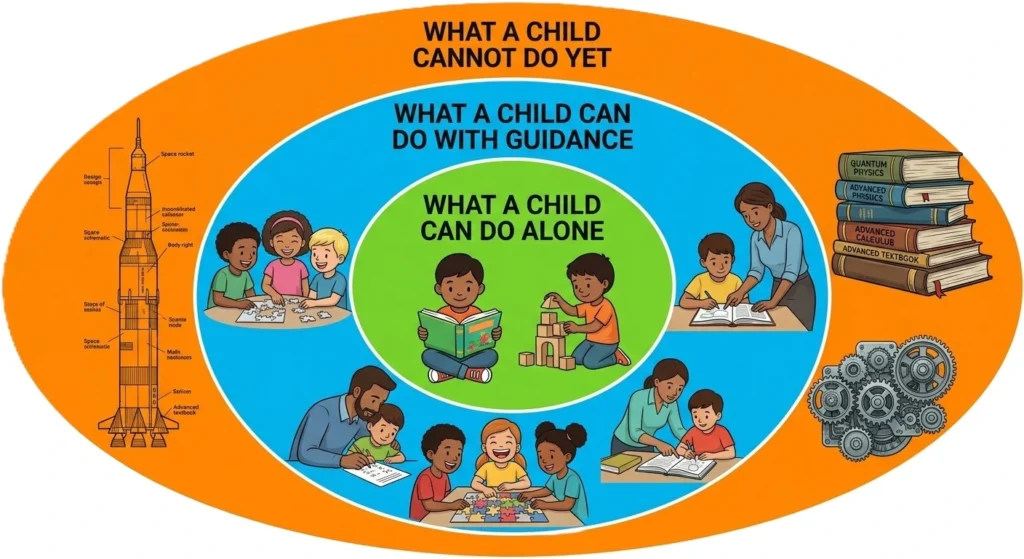
Examine the three concentric circles:
- Inner Circle: Vygotsky believes that in “What a child can do alone,” no learning happens. This is because once a child has already mastered a concept, simply repeating it does not lead to further cognitive development.
- Middle Circle (the ZPD): According to Vygotsky, true learning and cognitive growth occur when the learner learns with guidance from parents, an adult, teachers, and peers. When a child is guided, his learning actually grows. This is completely different from when they are left alone, where they don’t really learn anything new.
- Outer Circle: Vygotsky believes learners in this area cannot learn yet, even with maximum help, because they are not yet ready to adapt knowledge. For them, trying to learn those concepts is too frustrating.
3. Instructional Scaffolding
While Vygotsky never explicitly used the word “scaffolding” in his writings (the term was introduced later by psychologist Jerome Bruner), it is inseparable from the concept of ZPD.
Scaffolding refers to the temporary support from an MKO to the learner during the learning process. As the learner becomes more competent, this support gradually fades until they can perform the task completely on their own.
Example: When teaching a child to ride a bike, you start by holding the handlebars and seat (heavy scaffolding). Then, you hold the back of the seat. Eventually, you let go completely once they find their balance.
The Crucial Role of Language and Culture
Unlike other theorists who viewed language as a mere byproduct of cognitive development, Vygotsky believed language is the most important tool for gaining thoughts and knowledge.
He identified three stages of speech development in children:
Social Speech (External communication): At this stage (beginning around age 2), children learn to speak and communicate with others about how they see and feel. According to Vygotsky, learners cannot answer questions on their own because they have no inner speech. That’s why they use social speech to communicate and ask for help.
Private Speech (Self-talk): At this stage (beginning around age 3), children start talking to themselves out loud. They aren’t trying to converse with anyone else. Instead, they use their own voice to control their behavior, plan their actions, and think through problems.
- Example: A 4-year-old trying to solve a jigsaw puzzle alone. You might hear them say out loud, “The corner piece goes here… wait, it doesn’t fit… let me turn it this way.” They are using self-talk to guide their hands and brain until the task is done.
Inner Speech (Silent thinking): Around age 7, private speech goes underground and becomes completely silent. Children no longer need to speak out loud to think through a problem. Instead, their self-talk becomes internal thoughts, allowing them to think, plan, and reason quietly.
- Example: Imagine a 2nd-grade student silently reading a book or working on a math test in class. You won’t hear them make a sound, but inside their head, they are talking to themselves, saying, “Okay, seven plus five is twelve, so I carry the one…” They have successfully turned speech into quiet, structured thought.
Vygotsky also believed that culture shapes how we think and learn. For instance, a child raised in a rural farming community will develop different cognitive skills and tools than a child raised in a high-tech, urban environment. Culture hands us the mental tools to make sense of the world.
Conclusion: Why Vygotsky Matters Today
Lev Vygotsky’s Socio-Cultural Theory reminds us that human beings are fundamentally social creatures. Our minds are shaped by our conversations, our communities, and the people who guide us. By understanding the Zone of Proximal Development and the power of scaffolding, educators and parents can create supportive environments that push learners just enough to reach their highest potential.